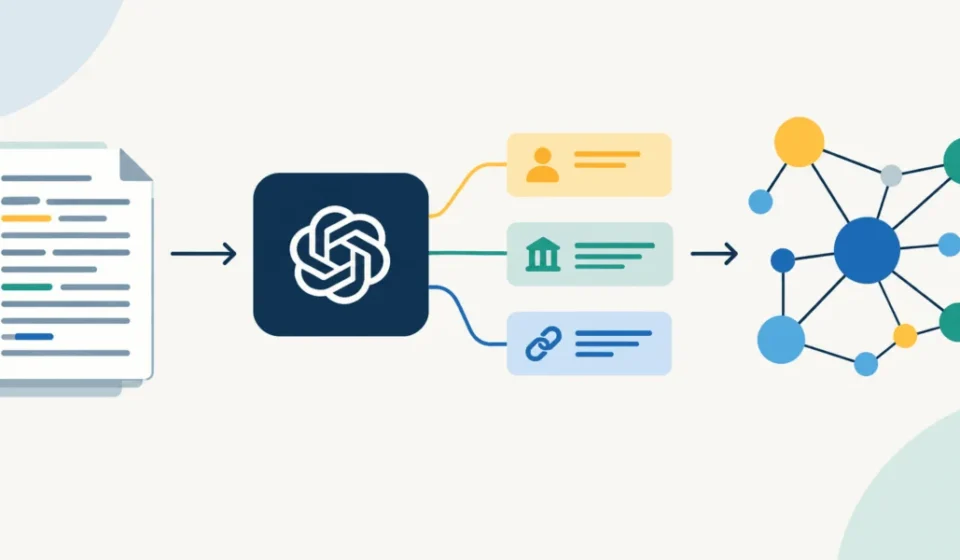
Automating Knowledge Graph Population: Extracting Entities and Triples from Unstructured Text with an LLM

The evolution of artificial intelligence has reached a critical juncture where the focus is shifting from the mere generation of text to the precision of data retrieval and the verification of facts. As large language models (LLMs) become integrated into enterprise workflows, the industry is grappling with the persistent challenge of hallucinations—instances where AI generates plausible but factually incorrect information. To mitigate this, developers are increasingly turning to Knowledge Graphs (KGs) to provide a deterministic foundation for Retrieval-Augmented Generation (RAG) systems. The process of building these graphs, once a labor-intensive task reserved for ontologists and data engineers, is now being revolutionized through automated extraction techniques using local LLMs. By leveraging tools such as Ollama and models like Llama 3.2, organizations can now transform vast quantities of unstructured narrative text into structured, queryable "SPOC" quads (Subject-Predicate-Object-Context), effectively bridging the gap between raw data and actionable knowledge.
The Shift from Vector Search to Deterministic Graph-RAG
For several years, the standard approach to enhancing LLM performance was the implementation of Vector RAG. This method involves converting text into numerical embeddings and storing them in a vector database. When a user asks a question, the system finds the most semantically similar text chunks and provides them to the LLM as context. While effective for general inquiries, vector search is often described as a "blunt instrument" because it relies on mathematical similarity rather than logical relationships. It cannot distinguish between a nuanced factual contradiction and a relevant supporting detail with high precision.
In contrast, a Graph-RAG system utilizes a Knowledge Graph as its primary source of truth. By representing information as a network of entities (nodes) and their relationships (edges), a graph allows for deterministic retrieval. This means the system can follow explicit logical paths to find answers, ensuring that the retrieved data is grounded in verified facts. The primary obstacle to adopting this architecture has been the "population problem"—the difficulty of extracting structured triples from messy, unstructured text. The methodology described herein provides a fully automated, local, and cost-effective solution to this bottleneck.
Technical Framework: The SPOC Quad Model
Traditional knowledge representation often relies on the Resource Description Framework (RDF), which utilizes triples in the format of (Subject, Predicate, Object). For example, "Alan Turing (Subject) was born in (Predicate) London (Object)." However, in modern AI applications, triples alone are often insufficient. To ensure data integrity and traceability, the "SPOC" quad model adds a fourth dimension: Context.
The inclusion of Context (C) allows the system to track the provenance of a fact—identifying whether a piece of information came from a specific Wikipedia article, a corporate PDF, or a real-time news feed. This contextual layer is vital for resolving conflicts; if two sources provide different birth dates for a historical figure, the context allows the RAG system to weigh the reliability of the sources or present both options to the user with their respective origins.
Infrastructure and Local Model Deployment
One of the most significant advancements in the current AI landscape is the ability to run powerful models locally. This shift is driven by concerns over data privacy, API costs, and the need for low-latency processing. Ollama has emerged as a leading framework for managing local LLMs, providing a streamlined interface for deploying models like Meta’s Llama 3.2.
Llama 3.2, despite being a "small" language model (SLM), is highly optimized for structured data extraction tasks. Its architecture allows it to follow complex instructions regarding JSON output formats, which is a mandatory requirement for automating the population of a database. By running these models on local hardware—such as a personal workstation or a private cloud instance—developers can process sensitive documents without exposing them to third-party providers.
The Automated Extraction Workflow
The process of automating knowledge graph population follows a rigorous four-stage chronology: infrastructure initialization, data ingestion, semantic extraction, and structured storage.
1. Infrastructure Initialization
The workflow begins by establishing a local server environment. Using Python’s subprocess module, the Ollama server is initiated in the background. The model of choice, Llama 3.2, is then "pulled" or downloaded to the local environment. This setup ensures that the entire extraction pipeline remains self-contained.
2. Data Ingestion
To demonstrate the system’s efficacy, raw text is typically sourced from a reliable repository. In many implementations, the Wikipedia API serves as the primary source. By targeting specific entries—such as the biography of Alan Turing—the system retrieves narrative summaries. At this stage, the text is still unstructured, containing complex sentences, parenthetical asides, and varying grammatical structures that would be impossible for a traditional regex-based parser to interpret.
3. Semantic Extraction via JSON Mode
The core of the system is the extraction engine. The LLM is prompted to act as an "expert data extraction algorithm." The prompt engineering involved here is specific: the model is instructed to identify atomic facts and format them into a JSON array.
To ensure the highest level of reliability, the model’s "temperature" is set to 0.0. In the world of LLMs, temperature controls randomness; a setting of 0.0 makes the model’s output deterministic, ensuring that it chooses the most likely token every time. This is crucial for data extraction, where consistency is prioritized over creativity. The model identifies the Subject, Predicate, and Object, while the script automatically appends the Context label (e.g., "Wikipedia_Alan_Turing").
4. Structured Storage in QuadStore
Once the LLM outputs the JSON data, the pipeline must parse this information and handle any potential formatting errors. Even with a temperature of 0.0, LLMs can occasionally vary their key names (e.g., using "Subject" instead of "subject"). A robust Python function is employed to normalize these keys, converting them to lowercase and stripping unnecessary whitespace.
The final step is the population of the QuadStore. In a lightweight implementation, the QuadStore is a Python class designed to manage the storage and querying of quads. It ensures that duplicate facts are not added and provides a query interface that allows the RAG system to retrieve facts based on any of the four dimensions.
Case Study: Processing the Alan Turing Dataset
When applied to the Wikipedia summary of Alan Turing, the automated system demonstrates remarkable precision. From just two paragraphs of text—roughly 1,200 characters—the system is capable of extracting approximately 11 to 15 distinct quads.
The extracted data includes biographical milestones:
- Subject: Alan Mathison Turing | Predicate: graduated from | Object: King’s College, Cambridge
- Subject: Alan Mathison Turing | Predicate: worked for | Object: Government Code and Cypher School
It also captures complex historical contributions:
- Subject: Alan Mathison Turing | Predicate: led | Object: Hut 8 (Bletchley Park)
- Subject: Alan Mathison Turing | Predicate: devised techniques for | Object: speeding the breaking of German ciphers
By converting these sentences into quads, the system creates a "web" of knowledge. If a user later asks, "Where did the father of theoretical computer science study?" the Graph-RAG system can link "Alan Turing" to "theoretical computer science" and then to "King’s College, Cambridge," providing a factual, multi-hop answer that a standard vector search might miss.
Industry Implications and the Future of Verifiable AI
The ability to automate the creation of Knowledge Graphs has profound implications for several sectors. In healthcare, this technology can be used to extract drug-to-drug interactions from medical journals. In finance, it can map the relationships between subsidiaries and parent companies from annual reports. In legal tech, it can track the precedence of court cases.
Industry analysts suggest that the move toward "Graph-Augmented Intelligence" is the next logical step in the maturity of AI. "We are moving away from the ‘magic’ of AI and toward the ‘accountability’ of AI," says one senior data architect. "If an LLM can tell you where it got a fact and show you the logical link in a graph, the trust gap closes significantly."
Furthermore, the reliance on local SLMs like Llama 3.2 democratizes this technology. Small and medium-sized enterprises (SMEs) no longer need massive budgets for OpenAI or Anthropic API credits to build sophisticated knowledge management systems. They can run these pipelines on standard consumer hardware, maintaining total control over their proprietary data.
Conclusion
Automating Knowledge Graph population represents a fundamental shift in how we handle unstructured information. By combining the linguistic intelligence of local LLMs with the structural rigor of SPOC quads, developers can build systems that are not only intelligent but also verifiable and deterministic. As the volume of digital information continues to grow, the ability to rapidly and accurately distill that noise into a structured graph will be the defining characteristic of the next generation of artificial intelligence. This workflow—from raw Wikipedia text to a populated QuadStore—serves as a blueprint for a future where AI hallucinations are replaced by grounded, traceable, and reliable knowledge.