Orchestrating the Multitude How Coding Agents are Redefining Developer Productivity and Task Management

The landscape of software engineering has undergone a fundamental transformation since the late 2022 introduction of Large Language Models (LLMs) into mainstream development workflows. As autonomous and semi-autonomous coding agents increasingly handle the granular implementations of software architecture, a new operational bottleneck has emerged: the management of the sheer volume of tasks these agents can process. This shift represents a move from the "art of writing code" to the "discipline of agent orchestration," where the primary challenge for senior engineers is no longer technical execution, but the cognitive overhead of tracking dozens of concurrent workstreams.
The Evolution of the Developer Bottleneck
Historically, the primary constraint in software development was the speed of human cognition and manual input. Before the proliferation of sophisticated coding agents, a single developer would typically focus on one complex task at a time. This sequential approach was dictated by the necessity of deep focus, the time required for manual research, and the physical limitations of writing and debugging code.
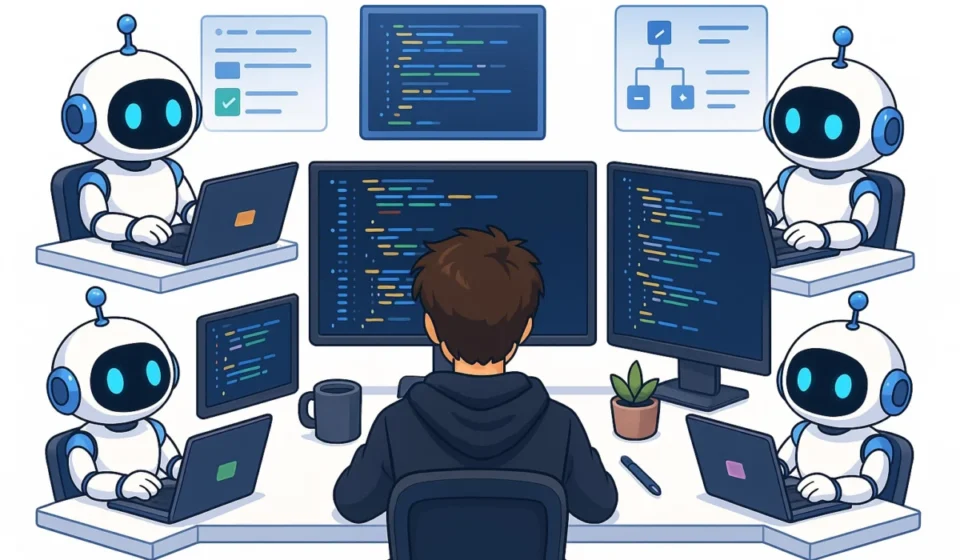
In the current technological climate, agents are essentially performing all primary coding implementations. This has inverted the traditional productivity model. Engineers are now reporting that the difficulty lies in keeping track of which coding agent is interacting with which task, the status of various pull requests, and the specific context of multiple parallel workflows. While this represents a significant leap in productivity, it necessitates a structural change in how engineering tasks are organized and monitored to prevent the gains from being neutralized by management debt.
Chronology of the Productivity Shift
The transition from manual-centric to agent-centric programming can be divided into three distinct phases:
- The Pre-AI Era (Pre-December 2022): Developers worked on tasks sequentially. A single feature implementation or a complex bug fix could span several days. Significant time was spent on "non-coding" activities, such as scouring documentation for new frameworks, manually resolving merge conflicts, and identifying syntax errors.
- The Copilot Era (2023): Developers began using AI as an "autocomplete" tool. Productivity increased, but the developer remained the primary driver of the logic. The "one task at a time" paradigm largely remained intact, though the speed of execution improved by an estimated 20% to 50% according to various industry benchmarks.
- The Agentic Era (2024–Present): The emergence of agents capable of multi-step reasoning, such as Claude Code, GitHub Copilot Workspace, and specialized internal tools. These agents can research, plan, write, and test code autonomously. This has enabled parallel task execution, where a single engineer manages five to ten active worktrees simultaneously.
The New Architecture of Task Management
To manage this increased velocity, high-performing engineers are adopting specialized workflows that treat coding agents as a distributed workforce rather than just a set of tools. A critical component of this new methodology is the use of isolated environments for every task.
Industry practitioners have begun utilizing "worktree" sessions or dedicated workspaces for each individual ticket. By spinning up a unique worktree—often through specialized applications like Emdash—developers can ensure that different agents do not interfere with each other’s file systems. A key tactical requirement in this workflow is the use of unique, descriptive naming conventions for each workspace. This allows the human overseer to identify the status and nature of a task at a glance without needing to parse the agent’s internal logs.
Furthermore, the integration of communication platforms like Slack into the agentic workflow has become standard. When a task is initiated via a Slack message or a product feedback loop, the agent is provided with a direct link to the conversation. This provides the AI with the necessary context and allows it to update stakeholders on progress automatically, further reducing the developer’s manual communication burden.
Data-Driven Productivity Gains and the "Dev-First" Strategy
The impact of these agents is most visible in the reduction of time spent on "maintenance" tasks. Previously, the following activities could consume a full workday:
- Unit test generation for legacy codebases.
- Refactoring complex functions for better readability.
- Generating boilerplate code for new API endpoints.
- Updating documentation to reflect recent changes.
Current data suggests these tasks are now completed in parallel and finished within hours. This has led to a controversial but increasingly popular "Dev-First" merging strategy. In this model, agents are authorized to merge code directly into development environments once automated tests pass. For lower-complexity tasks, developers have found that it is more efficient to allow the agent to merge and then fix any incidental issues in the development environment (which occurs in roughly 20% to 30% of cases) rather than manually verifying every line of code locally. This shift emphasizes "validation of outcome" over "verification of process."

To facilitate this, agents are now being tasked with creating automated HTML reports for every test cycle. These reports typically include:
- Visual screenshots of UI changes.
- Logs of successful and failed test cases.
- Links to the specific branch and deployment environment.
- A summary of the changes made versus the original requirements.
Comparative Analysis of Management Tools
As the need for orchestration grows, three primary categories of tools have emerged as the leaders in managing agentic workflows:
1. Linear: The Professional Standard
Linear has gained significant traction among developer-heavy organizations due to its streamlined, keyboard-centric interface. It allows for tight integration with coding agents, where an agent can be assigned a ticket URL, read the specification, create a branch, and update the ticket status automatically. Linear’s activity logs provide the necessary audit trail for human supervisors to monitor agent behavior across a large team.
2. Slack: The Real-Time Feedback Loop
For startups and rapid-response teams, Slack serves as an ad-hoc task manager. The primary advantage of Slack is its proximity to the end-user and product managers. By connecting agents directly to Slack channels, the "feedback-to-fix" loop is minimized. However, Slack lacks the structured "state management" of a dedicated project tool, making it less suitable for long-term project tracking or multi-developer coordination.
3. Notion: The Flexible Generalist
Notion remains a popular choice for individual developers and early-stage teams due to its Markdown-based flexibility and Kanban board capabilities. While it offers a clean interface for personal organization, it often struggles with the high-frequency updates generated by multiple autonomous agents, which can lead to a cluttered and difficult-to-navigate documentation structure as a company scales.
Implications for the Future of Software Engineering
The rise of agentic orchestration suggests that the role of the "Software Engineer" is evolving into that of a "Systems Architect and Reviewer." The primary skill set is shifting from syntax proficiency to systemic thinking and quality assurance.
Industry analysts suggest that the next phase of this evolution will involve "Agent Orchestrators"—meta-agents whose sole purpose is to manage other coding agents. These systems would automatically distribute tasks based on agent specialization, monitor for collisions in the codebase, and aggregate reporting for human stakeholders.
However, this transition is not without risks. The ease of generating code can lead to "code bloat" and an accumulation of technical debt if the orchestration is not handled with rigor. Companies that fail to optimize their task management systems risk being overwhelmed by the very productivity they sought to increase. As agents continue to perform the bulk of implementation, the "human in the loop" must focus on defining the "what" and the "why," leaving the "how" to the increasingly capable digital workforce.
In conclusion, the challenge of the modern era is not a lack of output, but a surplus of it. Success in the age of AI-driven development will be defined by an organization’s ability to build robust management frameworks that can keep pace with the tireless speed of autonomous coding agents. Spending time on optimizing these workflows is no longer an elective task for engineers; it is a fundamental requirement for maintaining a competitive edge in the software industry.